
PDRN, Decoded.
The Ingredient Everyone Is Talking About & Things to Know. Inclinical PDRN is not the same as topical “PDRN” & Why most “PDRN” serums don’t actually contain PDRN.

If you have worked in formulations or product development, you’ll recognise this moment. There’s a particular point in the lifecycle of a skincare ingredient where the marketing volume gets so loud that the actual science or its true value becomes impossible to hear. That’s what’s happening with PDRN.


First, Let Me Take You Back Ten Years
PDRN has been at that moment for a while now. But before we get into the science, let me tell you where I actually came in.
It’s 2016. I’m in Japan, and a Japanese formulator introduces me to a salmon-derived serum plus tablets she has created herself. She gifts them to me to test, 9,000 yen, not cheap. The serum was very hydrating. I started testing it as soon as I got home.
The thing is, I wasn’t entirely new to salmon in skincare. More than two decades ago, US brands were already experimenting with it. Remember Perricone MD’s Blue Plasma, a no-rinse daily facial peel using Hydrolyzed Roe, salmon egg enzyme, alongside copper for repair doing something adjacent. But what this Japanese formulator was introducing me to was categorically different. This was PDRN. Polydeoxyribonucleotide. Actual salmon DNA fragments. And it had been quietly developing in South Korea and Japan since the 1990s.
The origin story matters. Researchers in both countries, two places I’ve watched pioneer skincare science for my entire career were looking for natural, biocompatible substances that could genuinely enhance skin regeneration. Salmon DNA turned out to be a remarkably good candidate. Structurally similar to human DNA, rich in nucleotides the building blocks of cellular repair. The compatibility isn’t marketing language. It’s biology.
Yet there was one issue: here in the UK and US, we were deep in our Clean, Vegan, Free From era. Every brand was reformulating to meet retailers’ vegan requirements, and as a result PDRN was slow to take off in the West. But with the rise of brands like The Ordinary, increased skin education during COVID, and the creeping normalisation of Botox, clinical efficacy over clean was beginning to tip the balance. Customers began to prioritise results like never before preventative, science-backed, longevity-minded.
“If you want me to tape my face while I sleep to avoid wrinkles, I will.”
Most people only encountered PDRN post-COVID, when K-beauty brands amplified it and Rejuran from Pharmaresearch Inc., Gangneung-si, South Korea became impossible to ignore. I’ve watched their tradeshow presence go from a tiny slot eight years ago to a full platform installation, each iteration bigger, more confident, more mainstream. I’ve visited their booths in Hong Kong and Seoul, watched the crowds grow, watched it move from aesthetic medicine practitioners to everyday consumers.
When a brand’s tradeshow footprint expands like that, you’re watching an ingredient cross over.
The best-regarded topical serums right now Medicube’s PDRN Pink Peptide Serum, Rejuran’s Turnover Ampoule, Anua’s PDRN Hyaluronic Acid Capsule, Abib’s PDRN Glow Serum are all Korean, all salmon-derived or using vegan PDRN, all built around the same trending ingredient - but spoiler alert I haven’t added any into my routine. Yes they’re popular because their riding on the back of the aesethtic trend a good enough reason, but popularity and precision aren’t the same thing.
Plus you also know something is really taking off when you see a wave of published journals both independent and industry-backed flood the market. And that’s exactly what we’re seeing.
The quest for a youthful, smooth, and radiant appearance has always driven innovation in this space
Plus from a Formulator’s perspective, what we’re seeing now is a growing emphasis on naturally derived or biotech compounds in aesthetic & longevity medicine and PDRN sits squarely at that intersection.
So, What Exactly Is It?

PDRN stands for polydeoxyribonucleotide. It’s a mixture of small DNA fragments, most commonly derived from salmon DNA, originally studied in regenerative medicine and wound healing not skincare. They are complex molecules composed of nucleotides, the building blocks of DNA and RNA, shown to play a crucial role in cellular processes including cell proliferation, differentiation, and survival. It moved into aesthetic medicine, particularly injectable treatments in South Korea and only recently has it entered the topical cosmetics space.
In simple terms: it’s a DNA-derived ingredient that signals repair pathways in the skin.
The tables below are drawn directly from K. Lee et al.’s 2024 paper “Polynucleotides in Aesthetic Medicine: A Review of Current Practices and Perceived Effectiveness” it usefully consolidates the existing published research. One thing worth holding in mind: most papers originate from South Korea, a commercially successful ingredient generates its own research ecosystem, beauty is their biggest export and marketing is their BIGGEST strength- I expect PDRN to be pushed hard before the topical evidence fully catches up.
Table 1:
Polynucleotides for General Skin Condition (K. Lee et al., 2024)
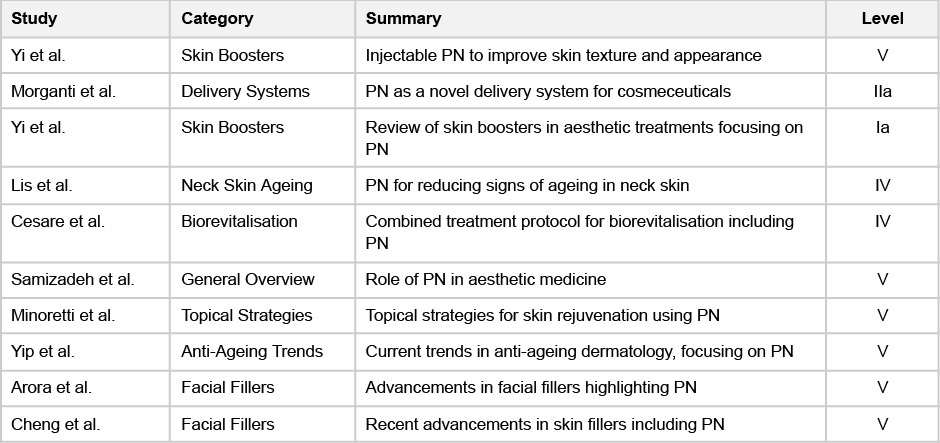
Table 2:
Polynucleotides for Miscellaneous Applications (K. Lee et al., 2024)

As you can see the studies are showing that injectable PDRN is showing some promising results……
A Brief History: How PDRN Got Here
1980s - Italian and South Korean researchers investigated polydeoxyribonucleotides for wound healing. Purely pharmaceutical.
Early 2000s - Injectable PDRN entered aesthetic medicine. The A2A adenosine receptor mechanism begins to appear in peer-reviewed literature
2010s - Rejuran launches in South Korea, positioning PDRN injectable treatments as “skin healers” rather than fillers.
Late 2010–early 2020s - K-beauty begins commercialising topical PDRN. Medicube, Abib, and Anua begin formulating it into serums.
2020–2021 - Post-COVID acceleration. pandemic-driven interest in barrier health, the rise of Tiktok drives K beauty and skin recovery, creating the perfect cultural moment.
2022–present - The Western market wakes up, then hypes up. The disconnect between injectable clinical data and topical cosmetic claims reaches its widest point, which is why I thought writing about might be interesting.
The Hylauronic Acid Parallel Worth Knowing
Funny enough HA and PDRN took opposite journeys to get where they are.
HA started topically; European luxury brands incorporated sodium hyaluronate into skincare as early as 1989, purely as a humectant. Restylane received FDA approval as the first HA dermal filler only around 2003, with Juvéderm following around 2006. Then topical HA came back more sophisticated: multi-weight molecules, cross-linked formulas, delivery systems that didn’t exist in the eighties.
PDRN did the reverse injectable first, topical second. The clinical rigour came before the serum. In some ways that makes PDRN’s topical evolution more promising: the mechanism is beginning to be understood, the injectable evidence is emerging. The topical science just needs time and rigorous formulation to catch up. But it also means the consumer market arrived before the topical evidence did, which is exactly the gap that creates hype without precision.
What Can It Actually Do Topically?
This is where I need you to hold two things at once.
Firstly K. Lee et al. 2024 paper - the most comprehensive review of published research concludes polynucleotides show promise for improving skin texture, reducing wrinkle depth and enhancing appearance.
But it also acknowledges:
Most evidence comes from observational studies and small pilot studies, not large-scale randomised controlled trials.
Study designs and outcome measures vary considerably
Most papers originate from South Korea - a commercially successful ingredient generates its own research ecosystem, beauty is their biggest export and marketing their BIGGEST strength.
Long-term efficacy is still an open question.
That’s the honest evidence picture. I guess the mechanism seems promising, but the topical translation still lagging.
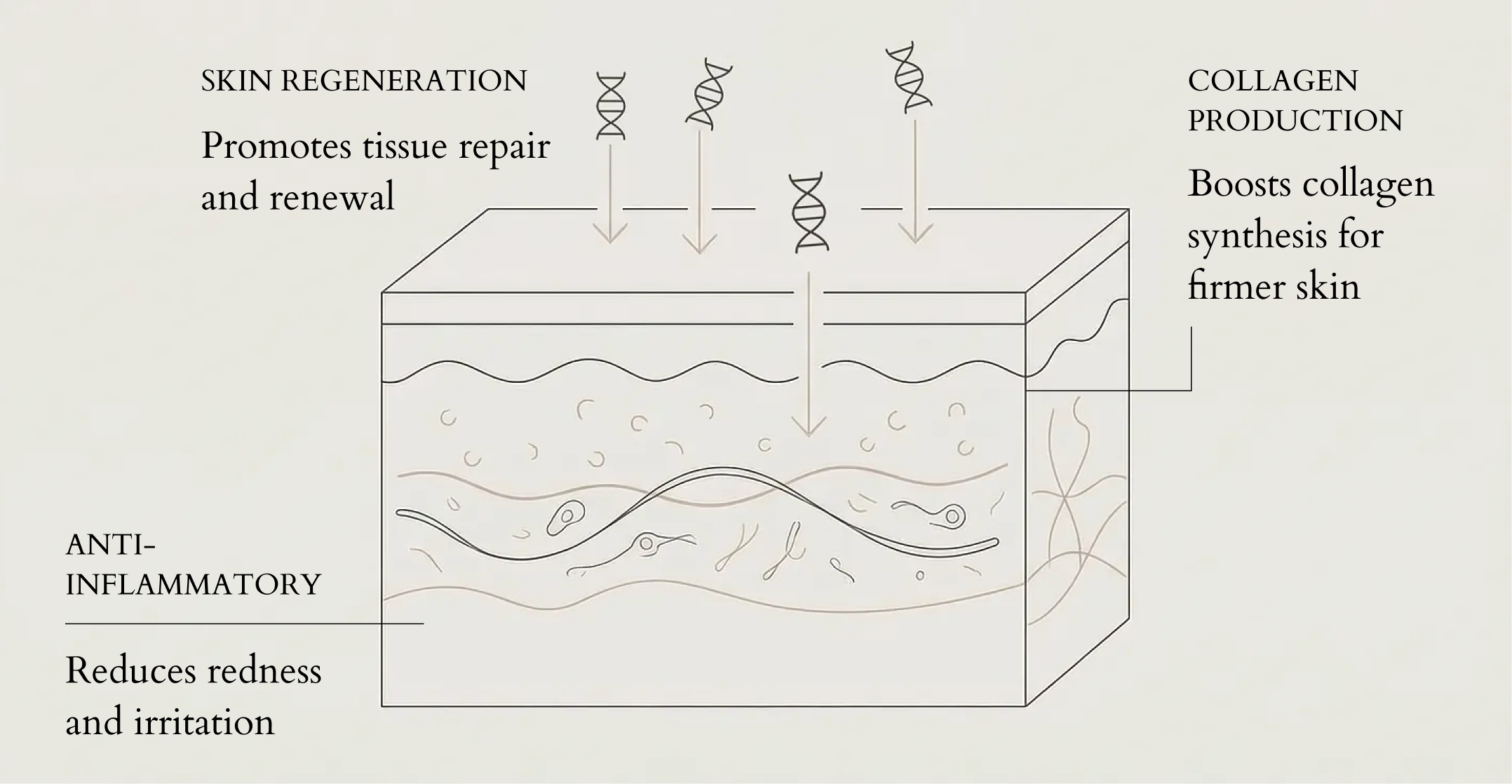
It’s a DNA-derived ingredient that signals repair pathways in the skin via the A2A adenosine receptor pathway, which triggers:
Anti-inflammatory response - calming damage at a cellular level
Fibroblast stimulation - your skin’s collagen-producing cells
Collagen synthesis - structural support from the inside out
Tissue repair - the same mechanism used in post-surgical recovery
** Yet keep in mind these benefits are referenced from aesthetics & injectables not topicals.
Here’s what most brands won’t tell you Real PDRN is medical-grade. Expensive to produce, not approved for cosmetic use in most global markets.
So what is actually in your serum?
Polydeoxyribonucleotide / PDRN Medical-grade, used in injectables and rarely in topical cosmetics.
Hydrolysed DNA or Sodium DNA Cosmetic-grade. Same salmon DNA source, processed differently. Broken into smaller fragments, lower molecular weight, easier for the skin to absorb. This is the cosmetic form, which you will find in serums like Annua PDRN & HA capsule serum (it references Sodium DNA). Rejuran Turnover Ampoule lists this as Hydrolysed DNA . Now for both of these products, I always recommend looking for a well rounded formulation with other supporting anti-inflammatories & ingredients.
Corallina officinalis Red algae. A botanical vegan stand-in is increasingly marketed under the PDRN banner. No polydeoxyribonucleotide in the INCI. This is also what Anua uses in it’s serum- alongside sodium hyaluronate, aloe, glycerin and other proven actives.
Before you spend your money. The critical variable nobody talks about enough: molecular size. PDRN is not a small molecule.
PDRN is a large molecule; fragments range from approximately 50–1,500 kDa.
Compare that to:
Niacinamide: 0.12 kDa
Low-molecular-weight hyaluronic acid: 5–20 kDa
Penetration into living skin layers is a genuine formulation challenge which is why it was launched as an injectable. Delivery systems, fragment size, and formula architecture will determine whether it's doing anything meaningful or just sitting on the surface hydrating at a superficial level. The ingredient on the label is only half the story.
So keep looking for well-rounded formulas with proven supporting actives.
So Why is PDRN everywhere?
So why has it become a BIG TREND? Well keep this in mind:
It started with aesthetic clinics
It carries more and more emerging scientific credibility with data around repair results
We are in a derma-functional skincare movement
Consumers want science-backed results
Medical-beauty crossover is just getting started
South Korean are genius marketers, but be warned they move to the next new thing very fast.
Who Does It Actually Make Sense For?
Based on where the evidence sits, primarily in-clinic aesthetic treatments:
Post-procedure skin after microneedling, peels or lasers
Sensitised or compromised skin struggling to recover
Skin that feels slow to bounce back
Ageing skin where regenerative signalling has naturally reduced
It's a resilience and repair ingredient; look to it for gentle recovery, really. Not an instant one. In your twenties with strong skin? It's not for you right now.
For topical formulations: look for well-rounded formulas where PDRN is supported by other proven actives, not standing alone as the hero claim.
What’s Actually in Your “PDRN” Serum?
This is where it gets interesting.
Real PDRN is medical-grade. Expensive to produce, tightly regulated, and not approved for cosmetic use in most global markets. Which is why the ingredient marketed as “PDRN” in a serum is almost never actual polydeoxyribonucleotide.
There are three distinct forms showing up in the market right now, and the difference matters:
Polydeoxyribonucleotide (Real PDRN)
Medical-grade. The form with the strongest clinical evidence and used in injectables. Not approved for cosmetic use in most global markets.
Hydrolysed DNA / Sodium DNA (Cosmetic-grade form)
The legitimate cosmetic form. Same salmon DNA source, processed differently , broken into smaller fragments with lower molecular weight, making it more accessible to the skin. Think of polynucleotide as a long string; Hydrolysed DNA is what you get when you cut that string into smaller pieces. Rejuran’s Turnover Ampoule uses this listed as Hydrolyzed DNA and marketed as c-PDRN®. It also contains Adenosine, which is directly relevant given PDRN works via the adenosine receptor pathway. The Rejuran works well because it’s a well-rounded formula, alongside niacinamide, bisabolol, licorice root, calendula, aloe, and sodium hyaluronate, all delivering calming and repair benefits in their own right.
Corallina officinalis (Botanical stand-ins or Vegan PDRN)
A red algae is increasingly used as a vegan botanical alternative and quietly marketed under the PDRN banner. This is what the Anua PDRN Hyaluronic Acid Capsule uses (alongside Sodium DNA). Not a bad product, well-formulated with sodium hyaluronate, aloe, glycerin and other proven actives. But it isn’t PDRN. As a consumer, you cannot confirm whether any benefit is coming from the algae, the HA, or the other ingredients doing the lifting.


What You Actually Need to Know Before Spending Your Money
Injectable and topical PDRN are not the same outcome. The evidence base is built on injected use. Topical expectations need to be calibrated accordingly, this will take time.
Formulation matters more than the ingredient. Concentration, molecular weight, and delivery system are everything. PDRN is a large molecule (fragments range 50–1,500 kDa far larger than niacinamide at 0.12 kDa, or the cosmetic low-molecular weight HA used in serums at around 50–300 kDa). Delivery systems will also impact efficacy of these serums.
It belongs in a repair-focused formula, not as a lone hero. It works best as part of a broader skin-recovery approach with supporting actives.
For in-clinic treatments, confirm the source. Most PDRN is salmon-derived. Ask for transparency on sourcing, purity, and supplier, get them to open the box in front of you. If they won’t, that’s your answer.
And the thing I keep coming back to: the marketing is currently louder than the data. That doesn’t mean PDRN is ineffective. The mechanism is genuinely interesting and the regenerative medicine research is solid. It just means we need to separate what we know from injectable and wound-healing studies from what we can claim about a £30–80 topical serum.
An Insider Peek at What’s Coming Next: A wave of Vegan PDRN
Remember when I talked about how the Clean and Vegan era slowed PDRN’s uptake in the West? That tension hasn’t gone away. There’s still significant demand for vegan and plant-derived skincare which means brands that want to participate in this ingredient moment need an alternative.
Which is why I’m now seeing raw material suppliers tout “botanical” or “vegan PDRN” alternatives. Cosmetic Business wrote a fab article on this recently here’s the LINK. It argues plant-based ingredients such as ginseng and algae offer anti-inflammatory and antioxidant benefits that support hydration, barrier repair and overall skin quality, which is why a number of brands are incorporating vegan alternatives to the marine-derived ingredient.

Corallina officinalis is one most visible right now and used in Annua PDRN & HA serum. Several brands are actively working in this space to develop plant-derived polynucleotide equivalents.
It feels very familiar to when Bakuchiol was positioned as a retinol alternative a genuinely interesting botanical that got caught up in a comparison it couldn’t always sustain, but excellent in its own right. Vegan PDRN is not necessarily inferior. But it is a different ingredient, and it will need its own evidence base,not borrowed credibility from salmon-derived research. As a product developer, I’m watching this space carefully.
The longevity filter applied here looks like this: watch, don’t chase topical formulations. The ingredient has real emerging biological credibility in aesthetic treatments. The topical evidence will compound over the next few years. When brands formulate it with genuine rigour, transparent molecular weight, proper delivery systems, and concentration levels, it will earn its place in a considered routine.
Until then, I’d rather you know exactly what you’re buying into.
To an ever-evolving you,
Love, Farah x
Farah is a cosmetic formulator and product developer with twenty years of industry experience, and the founder of Sachi Skin. She writes The Beam Files for women who want to choose well — and let it compound.
Wow, I learned so much from this, thank you!